Librarian's Book Selection Focuses on Spring Birds
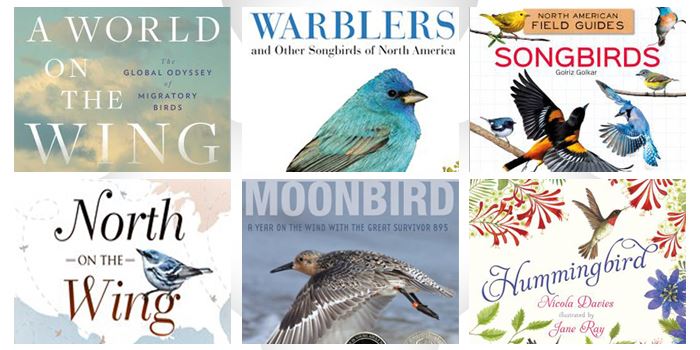
Recommended reading on nature related topics from librarians at the Toledo Lucas County Public Library.
Songbirds
By: Golriz Golkar
Find at your library: [print]
Young birders will be captivated by this handy field guide to North American songbirds. It includes vivid descriptions of 100 songbirds and details about where they are found. Full-color photos of each bird are helpful aids for identification. -- Publisher's website.
Hummingbird
By: Nicola Davis
Find at your library: [print]
Every spring, birds small enough to fit in the palm of your hand fly two thousand miles north to lay their eggs. This is the story of one tiny hummingbird's amazing journey. -- Bibliocommons
Moonbird: A Year on the Wind with the Great Survivor B95
By: Phillip Hoose
Find at your library: [print] [eBook] [Audio CD]
B95 can feel it: a stirring in his bones and feathers. It's time. Today is the day he will once again cast himself into the air, spiral upward into the clouds, and bank into the wind.
He wears a black band on his lower right leg and an orange flag on his upper left, bearing the laser inscription B95. Scientists call him the Moonbird because, in the course of his astoundingly long lifetime, this gritty, four-ounce marathoner has flown the distance to the moon--and halfway back!
B95 is a robin-sized shorebird, a red knot of the subspecies rufa. Each February he joins a flock that lifts off from Tierra del Fuego, headed for breeding grounds in the Canadian Arctic, nine thousand miles away. Late in the summer, he begins the return journey.
B95 can fly for days without eating or sleeping, but eventually he must descend to refuel and rest. However, recent changes at ancient refueling stations along his migratory circuit--changes caused mostly by human activity--have reduced the food available and made it harder for the birds to reach. And so, since 1995, when B95 was first captured and banded, the worldwide rufa population has collapsed by nearly 80 percent. Most perish somewhere along the great hemispheric circuit, but the Moonbird wings on. He has been seen as recently as November 2011, which makes him nearly twenty years old. Shaking their heads, scientists ask themselves: How can this one bird make it year after year when so many others fall?
National Book Award-winning author Phillip Hoose takes us around the hemisphere with the world's most celebrated shorebird, showing the obstacles rufa red knots face, introducing a worldwide team of scientists and conservationists trying to save them, and offering insights about what we can do to help shorebirds before it's too late. With inspiring prose, thorough research, and stirring images, Hoose explores the tragedy of extinction through the triumph of a single bird. Moonbird is one The Washington Post 's Best Kids Books of 2012. -- Bibliocommons
Warblers and Other Songbirds of North America
By: Paul Sterry
Find at your library: [eBook]
A stunning full-color photographic field guide of 285 species of North American songbirds and warblers, captured in glorious life-sized detail and featuring concise descriptions, location maps, and useful facts for both experienced birdwatchers and armchair ornithologists alike. Birds such as the Acadian Flycatcher, Golden-crowned Kinglet, Indigo Bunting, Northern Mockingbird, Pyrrhuloxia, Rock Wren, Song Sparrow, Tree Swallow, and the Yellow Throated Warbler are known for their elaborate songs produced by their highly developed vocal organs. Warblers and Other Songbirds of North America is a breathtaking collection of 285 species of these beautiful, melodious creatures, the largest number of species in a single field guide about North American songbirds. Arranged by region and taxonomic order, every songbird is depicted life-sized; each photograph is accompanied by a short description with essential information on identification and the particular species, habits, and behavior. Every species entry also includes a map showing where the species can be found, as well as a fact grid listing key details such as common and scientific name, length, food, habitat, status, and voice. Inside you'll find fun facts, including: Songbirds are members of the order Passeriformes, the most varied group of birds both in terms of numbers of species and diversity of appearance and habit preferences. Songbirds have feet that allow them to perch with ease, with three toes pointing forward and one facing back. Songbirds are extremely vocal; some male species are among the finest songsters in the bird world. Every photograph is gloriously detailed and chosen to show each species' unique identification features and typical postures. Packed in a convenient portable size, Warblers and Other Songbirds of North America is ideal for the experienced birdwatcher, the aspiring naturalist, and every bird lover. -- Bibliocommons
North on the Wing: Travels with the Songbird Migration of Spring
By: Bruce M. Beehler
Find at your library: [eAudio]
In late March 2015, ornithologist Bruce M. Beehler set off on a solo three-month trek to track songbird migration and the northward progress of spring through America. Traveling via car, canoe, bike, and on foot, Beehler followed woodland warblers and other neotropical songbird species from the southern border of Texas, where the birds first arrive after their winter sojourns in South America and the Caribbean, northward through the Mississippi drainage to its headwaters in Minnesota and onward to their nesting grounds in the north woods of Ontario.In North on the Wing, Beehler describes both the epic migration of songbirds across the country and the gradual dawning of springtime through the US heartland-the blossoming of wildflowers, the chorusing of frogs, the leafing out of forest canopies-and also tells the stories of the people and institutions dedicated to studying and conserving the critical habitats and processes of spring songbird migration.Inspired in part by Edwin Way Teale's landmark 1951 book North with the Spring, this audiobook-part travelogue, part field journal, and part environmental and cultural history-is a fascinating firsthand account of a once-in-a-lifetime journey. It engages listeners in the wonders of spring migration and serves as a call for the need to conserve, restore, and expand bird habitats to preserve them for future generations of both birds and humans. -- Bibliocommons
A World on the Wing
By: Scott Weidensaul
Find at your library: [print]
An exhilarating exploration of the science and wonder of global bird migration. In the past two decades, our understanding of bird migration-the navigational and physiological feats that enable birds to cross immense oceans or fly above the highest mountains, to go weeks without sleep, or remain in unbroken flight for months at a stretch-has exploded. Scientists have made astounding discoveries: certain species, such as thrushes, can avoid dehydration over long flights by "drinking" from their own muscles and organs, extending their flight range by almost thirty percent, or more than two thousand miles, and while we've known for decades that birds are somehow able to orient themselves using earth's magnetic field, a new leading theory is that they do so through a form of quantum entanglement. In A World on the Wing, author and researcher Scott Weidensaul shares these and other revelations to convey both the wonder of bird migration and its global sweep, taking the reader from the shores and mudflats of the Yellow Sea in China, to the remote mountains of northeastern India, and to the salt lakes in southern Cyprus in the Mediterranean. Weidensaul also introduces those trying to preserve global migratory patterns in the face of climate change and other rising challenges. -- Bibliocommons