The Twelve Weeks of Metroparks
By Karen Menard
Enjoy nature throughout the winter season by hiking many of the Metroparks trails. Consider joining the Metroparks Trail Challenge and making it a point to look for these species (highlighted below) during your treks in the New Year.
On the first week of Metroparks, the Oak Openings sent to me…an Oak Gall in an Oak Tree
The complexity and biodiversity of life found in the Oak Openings region is immense and well-illustrated by the fascinating lifecycle of a tiny wasp that has evolved to rely on a single oak tree. Its lifecycle actually starts below ground, where meals come from the roots. The next spring, wingless adult females emerge and move up the tree where they will inject an egg into a young leaf. As a result, the leaf balloons into a small, enclosed home where the developing adult can feed while being protected. A swollen, dried, gall (or growth) remains, resembling a small apple, often spotted along the trails during the winter season.
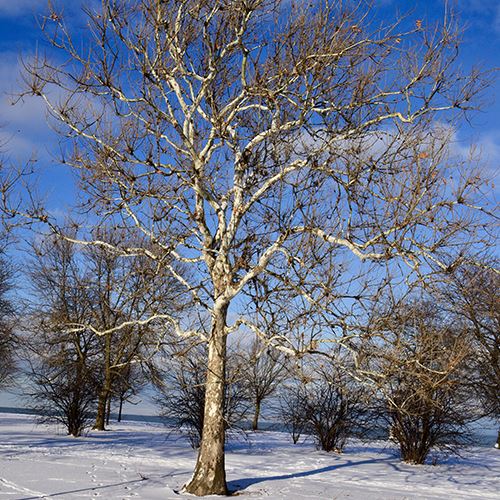
On the second week of Metroparks, the Black Swamp sent to me… Two Sycamores
Sycamore trees, while not the tallest in Ohio, are considered to be the largest trees with the ability to grow in circumference. This species can be identified best by its mottled look of darker, surface bark interfaced with the softer, pale bark underneath. Commonly seen growing in floodplains, along rivers and in swamps, this tree is difficult to confuse with other species. During the fall and winter, look for the spackled bark and the spherical seed heads that dangle from the crown like holiday ornaments.
On the third week of Metroparks, the Mighty Maumee sent to me…Three Cottonwoods
Cottonwoods, standing tall, always signal a water source—and aren’t found far from it. Mostly seen along riverbanks and floodplains, these trees are fast growing, stabilizing banks, while slowing the effects of erosion. In fact, mature individuals have the ability to use up to 200 gallons of water daily. After the tree is large enough, its thick, furrowed bark is easy to identify from a distance. Cottonwoods are fast growing.
On the fourth week of Metroparks, the Oak Openings sent to me…Four Calling Jays
“Jay…jay!” can still be heard among the snow covered oak trees in the Oak Openings. This keystone species is the main disperser of oak trees in these habitats.
Blue jays are acorn planting machines, responsible for selecting, caching, and planting thousands of viable acorns each fall. They can carry up to five acorns in their bill, throat and upper esophagus away from the parent trees, successfully dispersing the oaks to new areas within the region!
The jays and the oaks depend on one another, and the other species mentioned here depend on the oaks, as well as the insect and associated plant communities. On-going conservation in the Oak Openings region through corridor links and habitat restoration efforts will sustain natural connections.
On the fifth week of Metroparks, the Black Swamp sent to me…Five Hornet’s Nests
Mostly noticeable in the fall and winter and mainly hidden by leaves throughout the growing season, the football-sized, nest dangling from a branch was crafted by a small, flying insect called a bald-faced hornet. These insects tenaciously manufacture weatherproof construction paper by chewing wood fiber and mixing it with the starch present in own saliva. In the early spring, queens can be seen glued to tree stumps, mandibles busily scraping away at their building material of choice-- rotting wood. Through the season, the nest essentially becomes its own spherical creation as female workers continue the process of adding, layering, and seaming together thin, multi-hued bands of wood pulp.
On the sixth week of Metroparks, the Oak Openings sent to me…Six Shagbarks Swaying
The Shagbark Hickory was named for its distinctive, grayish-brown bark that appears “shaggy,” peeling away from its trunk in long, layered strips. Deep crevices formed under the bark are a perfect hiding place for roosting bats and Luna moths. This species is always an interesting one to try to spot during a winter hike in the Oak Openings. Look for the remnants of last fall’s hickory nut mast alongside the trails.
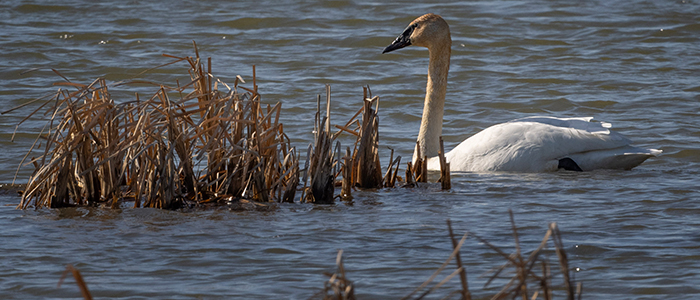
On the seventh week of Metroparks, the Lake Erie Marsh sent to me…Seven Swans a Swimming
Consider a trip to Howard Marsh Metropark in the next month to look for migrating flocks of tundra swans or overwintering trumpeter swans. Both species can often be seen floating or “swimming” in different areas of this Metropark. During late fall into winter, tundra swans migrate from their breeding grounds in the high arctic and pass through our area. Stopover flocks will feed mostly on aquatic plants, as well as mollusks, arthropods, and waste grain in adjacent farm fields. Sites like Howard Marsh are important stops for these migrants to rest and refuel along their long, arduous journeys.
Trumpeter swans actually nest in the Lake Erie marsh region, and many individuals can still be found using these areas during the winter season. In addition to the Lake Erie marsh sites, these birds also nest in central and southeastern Ohio. Considered to be the largest waterfowl species in North America, trumpeter swans can reach a weight of 26 pounds. Tundra swans differ in that they weigh in at a smaller size, have a shorter bill, and sport a yellow patch in front of their eyes.
On the eighth week of Metroparks, the Mighty Maumee sent to me…Eight Locusts Prickling
Honey locust trees, often seen growing near the Maumee River are actually named for the sweet, honey-like substance that is found inside of the long, flat seed pods, appealing to many wildlife species. Any mature, native Honey locust sports an important, protective layer of tough, prickly thorns growing alongside its trunk and branches. It is thought that this tree evolved a thorny defense which helped to ward off Pleistocene megafauna--like Mastodons, from stripping away bark and damaging the tree as they foraged for the tasty, sweet seedpods.
On the ninth week of Metroparks, the Oak Openings sent to me…Nine Woodcocks Dancing
As the curtain of ruby-orange twilight fades to dusk in early spring, the “timberdoodle,” or woodcock, makes its grand appearance. At the break of dawn or in the midst of the setting sun, the males take flight over northwest Ohio’s best meadow and prairie habitats.
Their feathered bodies launch themselves skyward in spiral bounds as phantom silhouettes against the veil of the night sky and the cosmos draws them loudly twittering upward, then, downward again in a rapid, warbling plummet-- similar to an out of control helicopter.
This outdoor spectacle doesn’t have anything to do with migration or finding prey. It ultimately intertwines aerial aerobatics with the allure of an impressive, moonlit dance meant to capture the attention of a waiting female. It is one of the most amazing courtship rituals found among birds.
On the tenth week of Metroparks, the Black Swamp sent to me…Ten (fox) Squirrels a Leaping
It is very easy to spot a fox squirrel during the winter months—they are considered to be the largest, native tree squirrel, weighing up to 2.5 pounds and at lengths of up to 27.5 inches! Many gain stature in our neck of the woods regularly visiting their favorite feeding station. During the winter season, watch and listen for the subtle and not-so-subtle ways of communicating warnings and attitudes with tail flicks chatter, and loud barking. Their agile nature, aided by double-jointed ankles, allows for great climbing skills that include headfirst maneuvers along trunks of trees. Additionally, fox squirrels always continue to impress through their ability to safely free fall at around 20 feet and their ability to perform horizontal leaps from up to fifteen feet away!
On the eleventh week of Metroparks, the Oak Openings sent to me…Eleven Peepers Peeping
Spring peepers are one of the first frog species to be heard in the spring, often calling when there is still snow on the ground in March. Singing from the depths of a ditch or shallow vernal pool, they are often difficult to see, as they only measure about an inch long. They get their name from the sound of the males’ mating call---a loud “peep” repeated about 20 times a minute. Frogs need clean wetlands and healthy vernal pool habitats to breed in, and many can be found in the area.
On the twelfth week of Metroparks, the Lake Erie Marsh sent to me…Twelve Beavers Damming
Beavers are considered to be the largest rodent in North America and are very skilled at instinctively building dams—mostly for safety from predators, controlling and managing water levels for their lodges, and improved food sustainability. A deeper, flooded area may bring more fish and is also a good place to store food underwater. Damming a pond or a stream will drastically change these areas into wetlands, affecting the larger ecosystem.
Photos: Trumpeter Swan: Art Weber; American Sycamore Tree: stock photo